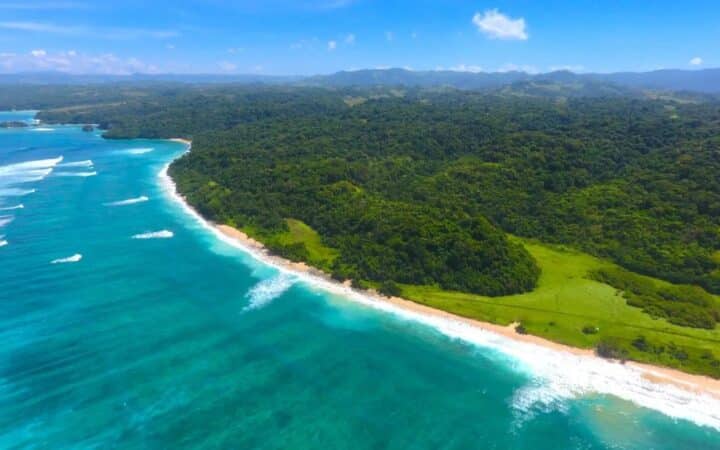
I need to say this before anything else: if what you want is Bali, go to Bali. It is a wonderful island and I am not going to pretend otherwise to sell you something else.
But a lot of people asking about Bali are not really asking about Bali. They are asking for the thing Bali was before seven million people a year found it. That is a different question, and it has a different answer.
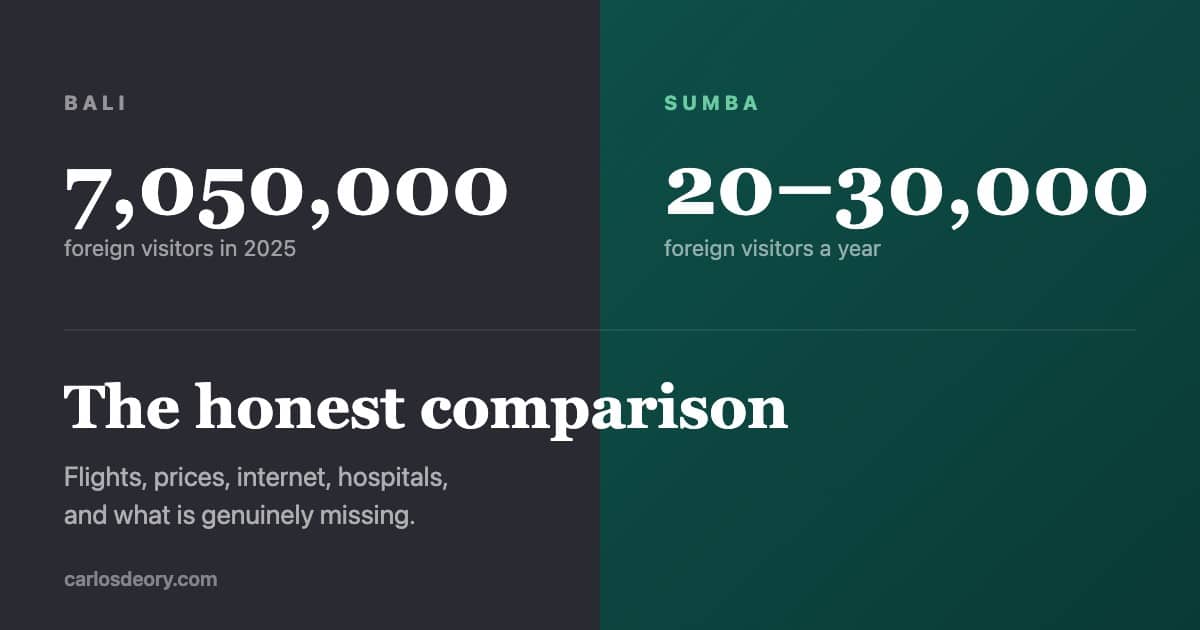
That is the whole article in two numbers. Bali received around 7.05 million foreign tourists through its airport in 2025. Sumba, an island of roughly the same size, gets somewhere between twenty and thirty thousand. For every visitor who lands in Sumba, around two hundred and fifty land in Bali.
Everything else follows from that.
Where Bali genuinely wins
Let me get this out of the way honestly, because a comparison where one side wins everything is an advert, not a comparison.
Getting there. Bali has direct flights from most of Asia and Australia. Sumba has one hop from Bali and that is it. Choice. Bali has thousands of restaurants, hundreds of coworking spaces, a yoga class at any hour and a dentist who speaks English. Sumba has a fraction of that. Solved problems. In Bali, whatever you need, somebody has already built the business that provides it. Nightlife. Sumba does not have any. Genuinely none.
If any of those four things is the reason you travel, stop reading. Bali is your island and you will have a great time.
The uncomfortable part nobody puts in these comparisons
Healthcare. The hospital nearest the west coast is in Waikabubak and it is a limited facility. If something serious happens, the realistic path is a medical evacuation flight to Bali or Singapore. Nihi, the resort at the other end of the island, tells its own guests that without an evacuation policy they should expect to pay around US$40,000 for that flight alone.
So here is my honest advice, and it costs me nothing to give it: get travel insurance with medical evacuation cover before you come. It is forty euros. Do not skip it. This is the single most important sentence in this article.
I would rather you read that here than find it out the hard way. It is also true of most of eastern Indonesia, and of a lot of places people go without thinking twice.
Getting there is easier than people assume
Bali to Tambolaka is about one hour and fifteen minutes, daily, on Nam Air or Wings Air, and it usually costs between fifty and a hundred and twenty dollars. Waingapu, on the east side, is around an hour and a half and flies four or five times a week.
The plane is small and the baggage allowance is small with it, usually ten to fifteen kilos checked. Tambolaka airport has no jet bridge and no baggage carousel. You walk across the tarmac and pick your bag off a counter. I like that about it, but I understand if you do not.
The weather is genuinely better
This one surprises people. Sumba sits further east and drier than Bali. The dry season runs April to October, with temperatures between 25 and 33 degrees and noticeably lower humidity than you get in Bali. The east of the island is dry savannah, which looks like nowhere else in Indonesia. The west is greener.
The rainy season is November to March, and it rains properly, so plan around it. But a working trip between April and August in Sumba is a different physical experience from the same trip in Bali. You sweat less and you sleep better.
The internet actually works
This was the objection that used to end the conversation, and Starlink ended the objection. We run a coworking space in front of the sea and people take video calls from it all day. One of our guests, who came to work rather than to holiday, wrote afterwards that the Starlink worked really well, even for video calls. That is a sentence nobody could have written about this island four years ago.
It is the single change that turned Sumba from a place you visit into a place you can stay.
Your money goes considerably further
Sumba has roughly fifteen hundred hotel rooms on the entire island. At the top end sits Nihi, voted the best hotel in the world, at around two thousand dollars a night. Below that, the market barely exists, which means the gap between what you pay and what you get is the widest I have seen anywhere in Indonesia.
The same applies to land and to building. It is precisely why we are here and I am not going to pretend that is a coincidence.
And then there is the culture, which is not a show
This is the part that made me stop and pay attention, and it is the hardest to convey in a comparison table.
Between a quarter and a third of Sumbanese still practise Marapu, an ancestral religion older than every organised faith that arrived afterwards. People are buried under enormous carved stone slabs in the middle of the village, a burial tradition believed to go back more than four and a half thousand years, and it is still happening now, not in a museum. The ikat cloth takes months to weave a single piece. The Pasola is a ritual spear fight on horseback, tied to the agricultural cycle, and it is not put on for anybody.
In Bali the culture is magnificent and it is also, in the tourist areas, partly performed for you. In Sumba nothing is performed for you, because there is almost nobody to perform it to.
The honest table
| Bali | Sumba | |
|---|---|---|
| Foreign visitors a year | ~7,050,000 | 20,000–30,000 |
| Getting there | Direct from most of Asia and Australia | 1h15 from Bali, daily, $50–120 |
| Weather Apr–Oct | Hot and humid | 25–33°C, drier, lower humidity |
| Internet | Fibre in most areas | Starlink, holds video calls |
| Hospitals | International hospitals in Denpasar | Limited. Insure for evacuation |
| Crowds and traffic | The main complaint of residents | Effectively none |
| Restaurants and choice | Thousands | Few, and closing early |
| Value for money | Rising fast | Widest gap I have seen |
| Living culture | Magnificent, partly performed | Marapu, ikat, Pasola. Not for you |
| Nightlife | Anything you want | None. Truly none |
So what is actually missing in Sumba
Plainly, so you cannot say I did not tell you. Specialist medical care. A wide choice of restaurants. Direct international flights. Roads that are good everywhere rather than good in places. Deliveries that arrive tomorrow. Anything at all to do after ten at night. And a reliable supply of the specific brand of anything you are attached to.
My verdict, and I am not neutral
If it is your first time in Indonesia and you have ten days, go to Bali. You will see extraordinary things and everything will be easy.
If you have been to Bali, and the thing you remember is the traffic on the way to the temple rather than the temple, come to Sumba. If you can work from anywhere and you are tired of doing it in a room full of people doing exactly the same thing, come to Sumba. If you want your children to see a culture that is not staged, come to Sumba.
And be aware that this is a window, not a permanent state. Bali was also empty once.
Why we are building a town here See Eco Beach City
Full disclosure: I am not a neutral observer. I am building a beachfront town on the north coast of Sumba, so I have an obvious interest in you finding the island interesting. That is exactly why I put the hospital paragraph near the top instead of hiding it at the bottom. If I only tell you the good parts, you come once, have a bad time, and never come back. That is a terrible business.
Antes que nada tengo que decir una cosa: si lo que quieres es Bali, vete a Bali. Es una isla maravillosa y no voy a fingir lo contrario para venderte otra cosa.
Pero mucha gente que pregunta por Bali no está preguntando por Bali. Está preguntando por lo que Bali era antes de que siete millones de personas al año la encontraran. Esa es otra pregunta, y tiene otra respuesta.
Ahí está el artículo entero en dos números. Bali recibió unos 7,05 millones de turistas extranjeros por su aeropuerto en 2025. Sumba, una isla de tamaño parecido, recibe entre veinte y treinta mil. Por cada visitante que aterriza en Sumba, aterrizan unos doscientos cincuenta en Bali.
Todo lo demás sale de ahí.
En qué gana Bali de verdad
Dejo esto claro desde el principio, porque una comparación en la que un lado gana en todo no es una comparación, es un anuncio.
Llegar. Bali tiene vuelos directos desde casi toda Asia y Australia. Sumba tiene un salto desde Bali y ya está. Variedad. Bali tiene miles de restaurantes, cientos de coworkings, una clase de yoga a cualquier hora y un dentista que habla inglés. Sumba tiene una fracción de eso. Problemas resueltos. En Bali, necesites lo que necesites, alguien ya montó el negocio que lo soluciona. Vida nocturna. Sumba no tiene. Ninguna, literalmente.
Si alguna de esas cuatro cosas es la razón por la que viajas, deja de leer. Bali es tu isla y lo vas a pasar muy bien.
La parte incómoda que nadie mete en estas comparaciones
Sanidad. El hospital más cercano a la costa oeste está en Waikabubak y tiene medios limitados. Si pasa algo grave, el camino realista es un vuelo de evacuación médica a Bali o Singapur. Nihi, el resort del otro extremo de la isla, avisa a sus propios huéspedes de que sin póliza de evacuación cuenten con pagar unos 40.000 dólares solo por ese vuelo.
Así que este es mi consejo honesto, y darlo no me cuesta nada: contrata un seguro de viaje con cobertura de evacuación médica antes de venir. Son cuarenta euros. No te lo saltes. Es la frase más importante de este artículo.
Prefiero que lo leas aquí a que lo descubras por las malas. Y vale igual para casi todo el este de Indonesia, y para un montón de sitios a los que la gente va sin pensarlo dos veces.
Llegar es más fácil de lo que la gente supone
De Bali a Tambolaka hay una hora y cuarto, todos los días, con Nam Air o Wings Air, y suele costar entre cincuenta y ciento veinte dólares. A Waingapu, en la parte este, hora y media, cuatro o cinco veces por semana.
El avión es pequeño y la franquicia de equipaje también, normalmente de diez a quince kilos facturados. El aeropuerto de Tambolaka no tiene pasarela ni cinta de equipajes. Cruzas la pista andando y recoges la maleta de un mostrador. A mí eso me gusta, pero entiendo que a ti no.
El tiempo es objetivamente mejor
Esto sorprende a la gente. Sumba está más al este y es más seca que Bali. La estación seca va de abril a octubre, con temperaturas entre 25 y 33 grados y bastante menos humedad de la que hay en Bali. El este de la isla es sabana seca, que no se parece a ningún otro sitio de Indonesia. El oeste es más verde.
La época de lluvias es de noviembre a marzo, y llueve en serio, así que organízate en consecuencia. Pero un viaje de trabajo entre abril y agosto en Sumba es una experiencia física distinta al mismo viaje en Bali. Sudas menos y duermes mejor.
El internet funciona de verdad
Esta era la objeción que antes terminaba la conversación, y Starlink terminó con la objeción. Tenemos un coworking frente al mar y la gente hace videollamadas desde ahí todo el día. Uno de nuestros huéspedes, que vino a trabajar y no de vacaciones, escribió después que el Starlink funcionaba muy bien, incluso para videollamadas. Esa frase no la podía haber escrito nadie sobre esta isla hace cuatro años.
Es el único cambio que convirtió Sumba de un sitio al que se va a un sitio en el que se puede estar.
Tu dinero cunde muchísimo más
Sumba tiene unas mil quinientas habitaciones de hotel en toda la isla. Arriba del todo está Nihi, votado mejor hotel del mundo, a unos dos mil dólares la noche. Por debajo de eso, el mercado casi no existe, lo que significa que la diferencia entre lo que pagas y lo que recibes es la más grande que he visto en toda Indonesia.
Con la tierra y con la construcción pasa lo mismo. Que es exactamente por lo que estamos aquí, y no voy a fingir que sea casualidad.
Y luego está la cultura, que no es un espectáculo
Esta es la parte que me hizo parar y prestar atención, y la más difícil de meter en una tabla comparativa.
Entre una cuarta parte y un tercio de los sumbaneses siguen practicando el Marapu, una religión ancestral más antigua que todas las religiones organizadas que llegaron después. La gente se entierra bajo losas de piedra enormes talladas, en mitad del pueblo, una tradición funeraria que se cree que tiene más de cuatro mil quinientos años, y sigue pasando hoy, no en un museo. Un solo tejido de ikat lleva meses de trabajo. La Pasola es un combate ritual de lanzas a caballo, ligado al ciclo agrícola, y no se monta para nadie.
En Bali la cultura es magnífica y también está, en las zonas turísticas, en parte representada para ti. En Sumba no se representa nada para ti, porque casi no hay nadie para quien representarlo.
La tabla honesta
| Bali | Sumba | |
|---|---|---|
| Visitantes extranjeros al año | ~7.050.000 | 20.000–30.000 |
| Llegar | Directo desde casi toda Asia y Australia | 1h15 desde Bali, diario, 50–120 $ |
| Tiempo abr–oct | Calor y humedad | 25–33°C, más seco, menos humedad |
| Internet | Fibra en casi todas partes | Starlink, aguanta videollamadas |
| Hospitales | Hospitales internacionales en Denpasar | Limitados. Asegúrate la evacuación |
| Masificación y tráfico | La queja número uno de quien vive allí | Prácticamente nula |
| Restaurantes y variedad | Miles | Pocos, y cierran pronto |
| Relación calidad-precio | Subiendo rápido | La mayor diferencia que he visto |
| Cultura viva | Magnífica, en parte representada | Marapu, ikat, Pasola. No es para ti |
| Vida nocturna | La que quieras | Ninguna. De verdad, ninguna |
Qué falta de verdad en Sumba
Claro y en orden, para que no digas que no te avisé. Atención médica especializada. Variedad de restaurantes. Vuelos internacionales directos. Carreteras buenas en todas partes y no buenas a ratos. Envíos que llegan mañana. Absolutamente nada que hacer después de las diez de la noche. Y suministro fiable de esa marca concreta a la que le tengas cariño.
Mi veredicto, y no soy neutral
Si es tu primera vez en Indonesia y tienes diez días, vete a Bali. Vas a ver cosas extraordinarias y todo va a ser fácil.
Si ya has estado en Bali, y lo que recuerdas es el atasco de camino al templo y no el templo, vente a Sumba. Si puedes trabajar desde cualquier sitio y estás cansado de hacerlo en una sala llena de gente haciendo exactamente lo mismo, vente a Sumba. Si quieres que tus hijos vean una cultura que no está montada, vente a Sumba.
Y ten en cuenta que esto es una ventana, no un estado permanente. Bali también estuvo vacía alguna vez.
Por qué estamos construyendo un pueblo aquí Ver Eco Beach City
Aviso: no soy un observador neutral. Estoy construyendo un pueblo frente al mar en la costa norte de Sumba, así que tengo un interés evidente en que la isla te parezca interesante. Precisamente por eso he puesto el párrafo del hospital arriba y no escondido al final. Si solo te cuento lo bueno, vienes una vez, lo pasas mal y no vuelves. Eso es un negocio pésimo.